

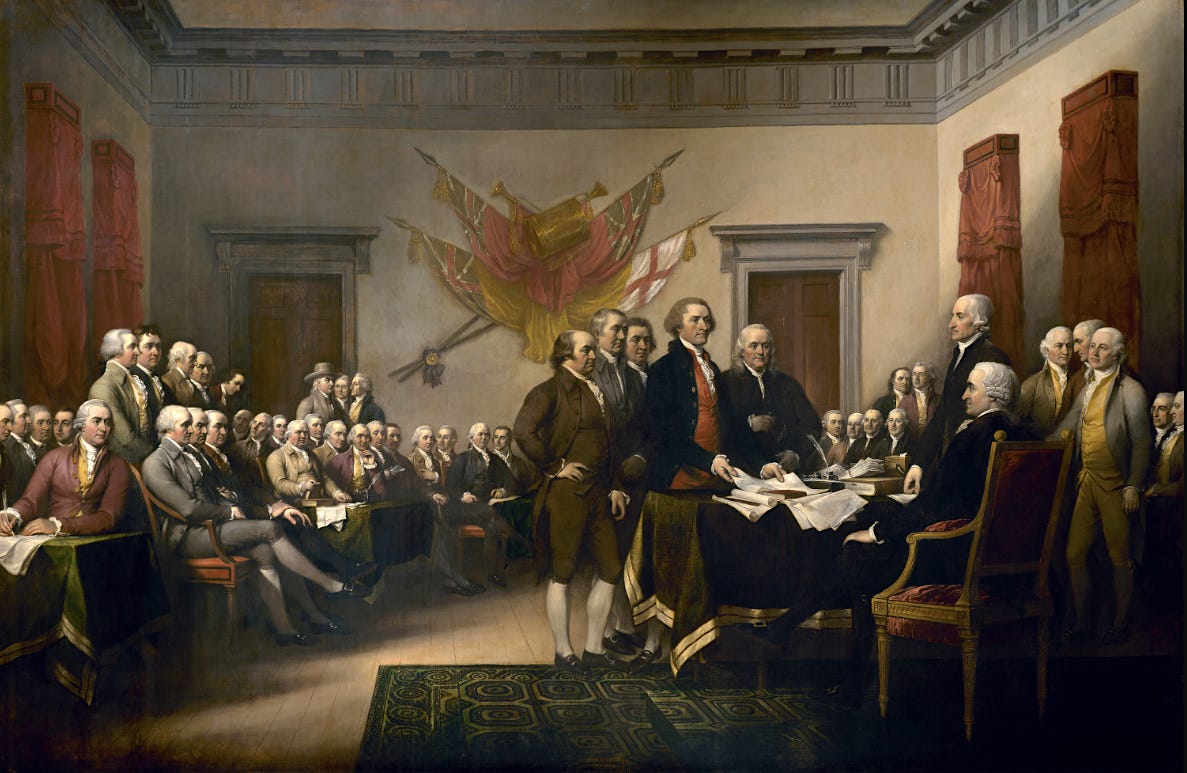
“We hold these truths to be self-evident...” —every American knows these words and the unalienable rights written out in the Declaration of Independence. We are taught from our earliest school years about life, liberty, and the pursuit of happiness. But how many more words of our founding document do you actually know?
Looking back into history, the Declaration marks the beginning. Its signing marked for all time the creation of a nation with a certain set of beliefs as its backbone. This is the nation that we still celebrate 250 years later. But this document was far more than that to the signers.
While it was a beginning for the men who signed it, this document was also an end. It was the final statement of colonists who had grown disillusioned with their mother country; the final note of a decade-long symphony filled with harsh cymbal crashes, sweet flute solos, and deep crescendos. For the men at the Second Continental Congress, this was also an opportunity to convince the rest of the colonial world that independence was necessary.
So we ought to, as good Americans, understand its arguments and purpose, not only for us today, but for the original readers in 1776.
To be sure, it wasn’t just the planters like Jefferson and Washington, nor the lawyers like John Adams and Robert Treat Paine, nor the traders like John Hancock who felt the rebellious spirit. Since the passing of the Stamp Act, everyone who bought or sold anything felt the pain of the taxes and trade barriers imposed. In the cities, harassment from soldiers made matters even worse. But, the idea of independence was still one that was bandied about in smoke-filled parlors and in letters discussing philosophy.
For most of the colonists, these pains were caused by Parliament, not through any action of the king. So many remained loyal to the crown while placing every tax, fee, and annoying official at the feet of those damned Tories. Furthermore, the learned colonists understood that British Common Law was what had granted them the rights that were being undercut. So protest as they might, they were still Englishmen, and wished to remain so. So there remained a rift between the common folk and the rich elites.
Thomas Paine’s Common Sense began to bridge that gap. He denounced monarchy as an institution that had “laid (not for this or that kingdom only) but the world in blood and ashes.” He then moved on to attack the British government, King George III, and even Englishness itself. He states that if Britain is the mother of America, “then shame upon her conduct. Even brutes do not devour their young, nor savages make war upon their families.” To that end, “independence of this country on Britain…like all other truths discovered by necessity, will appear clearer and stronger every day.” For Paine, it was vital that the new nation forge ahead separated not only from the British monarchy, but from their British identity as well.
When Paine’s words were published in January 1776, there was still hope, even among some of the elites, that reconciliation was possible. By summer, after tens of thousands of people had read Common Sense, it was clear and obvious that independence was the only true option. Before the Second Congress signed their own Declaration for the new nation, cities, counties, and even whole colonies were declaring their independence from Great Britain. Paine’s prediction was correct, and many of his radical desires became commonplace. These desires were heard in Philadelphia, and on June 7, 1776, it was agreed that independence must be declared.
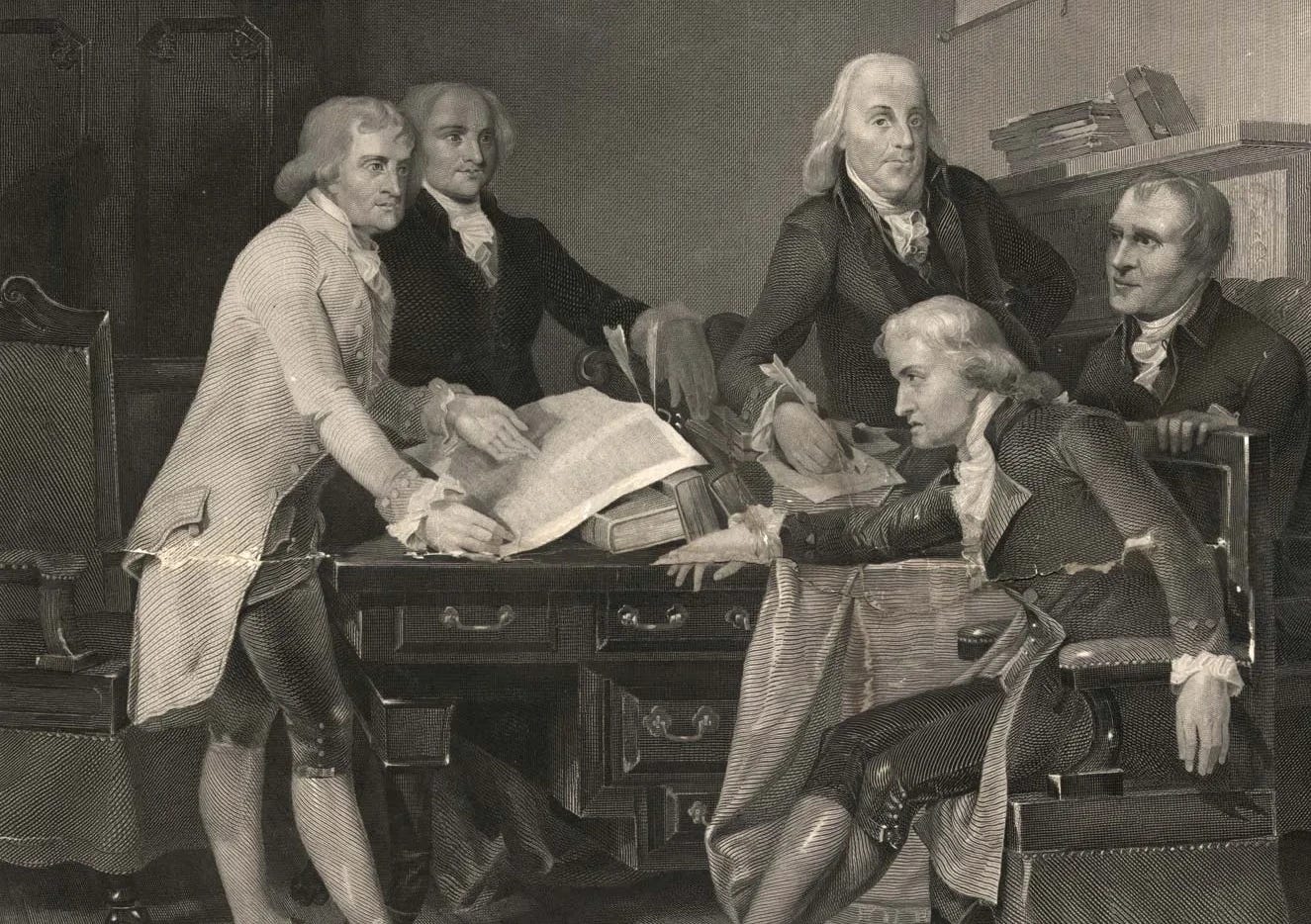
A committee of five men was formed: John Adams, Roger Sherman, Robert Livingston, Benjamin Franklin, and Thomas Jefferson. These men were among the most well-read and clear thinkers in the colonies. However after being chosen as the drafter, Jefferson sequestered himself and began writing. The first draft would be his words alone. Using no notes as a guide, he merged arguments he had written months prior in his Summary View of the Rights of British America with the philosophies of John Locke, David Hume, Edward Coke, Algernon Sidney, and even Cicero to make it plain why independence was necessary.
But, Jefferson knew this document had to do more than just state the God-given rights of men and the role of government. He had to make the argument for going to war. This war was not only against their old government, but against their kinsmen.
The well-read—many of whom sat within the walls of the Pennsylvania State House—were not so bold as to dismiss their British origins. They knew the history of the legal code, and did not wish to abandon it wholesale. The rights it afforded were worth keeping. They were willing to ditch the king, though. He was the root of all problems. Conversely, many ordinary colonists, while willing to abandon British custom, still held the king in high esteem.
The world in which Jefferson was writing was a world that is unrecognizable to us moderns. It is obvious to us that oppressive forces should be challenged, doubly so if that force is illegitimate. To Jefferson, and Thomas Paine of course, both were true of King George. But to most colonists, no matter their feelings toward independence, there remained a deep affection for the king, their patriarch. It would take some convincing to sour their image of him.
So, Jefferson had to use this declaration to break both connections and close this rift.
To do this, Jefferson explained the regret the Americans felt at being betrayed by their own kin across the sea. However, he did not lay blame at their British brothers and sisters, but rather the king. The majority of the draft was thus a listing of all of the failures of King George in protecting British rights in America as well as the harm done in the process. Thus, though the first two paragraphs are what endure in American minds today, the rest of the document proved most critical to ensure the revolutionary cause reached American hearts in 1776.
Jefferson knew the historical precedent, political philosophy, and specific grievances so well that after just two weeks of writing he finished the draft and brought it to the committee. The four other men pored over the document, critiquing line by line as Jefferson watched on anxiously. Many changes were made; most were minor, though, as they knew the larger Congress would likely drive even more edits.
One change is important to note, however. Jefferson originally wrote that American rights were “sacred and undeniable.” The draft given to Congress stated that rights were instead “self-evident.” It is not known who suggested the edit, but this new phrase brought with it the power to remain forever ingrained in every American’s head.
On June 28, the draft was submitted to Congress for debate. In the end, more than eighty changes were made, with John Adams taking on the document as his defendant in this trial for the future of America. Most were minor adjustments of word choice, but there were two major cuts.
The first was to remove entirely Jefferson’s portrayal of their independence as a mortal wound to the affection they felt toward the British people. To Jefferson, the Declaration was in a sense a reaction to a betrayal felt among the American colonists. It was a calamity that these kin on either side of the ocean should turn to violence. The Congress did not agree. Rather, they sided with the general population: Americans were not British and ought to make the separation clear.
Congress also removed a clause stating that the king had forced slavery upon the colonies. It was well understood by all the men in that room that slavery was an institution fully embedded in the colonial. They also, like Jefferson, understood the contradiction built into the document—that all men are created equal in a slave society. But this clause created far too much instant tension for the new nation. Further, many of them either owned slaves or dealt in the slave trade, and for the Declaration to pass, all thirteen colonies needed to agree, including Georgia and South Carolina who were incredibly reliant on the practice. Thus, unity won against the moral stain, and the clause was removed.
After the final edits were completed, on July 2, the Declaration was put to a vote. Twelve colonies voted in the affirmative, and New York abstained (though it would later assent). For many in the room the passing brought jubilation, for others deep solemnity, and for some a moment of somber reflection. They had crossed the Rubicon. There was no turning back.


The image of all of these men standing in line waiting their turn to sign under John Hancock’s ornate signature may enter your head, but it is likely that this did not happen. Some present stated that they signed the original copy while others denied it. So that will remain a mystery. Regardless, the document was finalized, and copied for distribution. The final engrossed copy—the one that is now faded to near blank paper in the National Archives—was signed a month later on August 2. By then, the words of the Declaration had been spread throughout the colonies:
The unanimous Declaration of the thirteen united States of America, When in the Course of human events, it becomes necessary for one people to dissolve the political bands which have connected them with another, and to assume among the powers of the earth, the separate and equal station to which the Laws of Nature and of Nature’s God entitle them, a decent respect to the opinions of mankind requires that they should declare the causes which impel them to the separation.
We hold these truths to be self-evident, that all men are created equal, that they are endowed by their Creator with certain unalienable Rights, that among these are Life, Liberty and the pursuit of Happiness.—That to secure these rights, Governments are instituted among Men, deriving their just powers from the consent of the governed, —That whenever any Form of Government becomes destructive of these ends, it is the Right of the People to alter or to abolish it, and to institute new Government, laying its foundation on such principles and organizing its powers in such form, as to them shall seem most likely to effect their Safety and Happiness. Prudence, indeed, will dictate that Governments long established should not be changed for light and transient causes; and accordingly all experience hath shewn, that mankind are more disposed to suffer, while evils are sufferable, than to right themselves by abolishing the forms to which they are accustomed. But when a long train of abuses and usurpations, pursuing invariably the same Object evinces a design to reduce them under absolute Despotism, it is their right, it is their duty, to throw off such Government, and to provide new Guards for their future security.—Such has been the patient sufferance of these Colonies; and such is now the necessity which constrains them to alter their former Systems of Government. The history of the present King of Great Britain is a history of repeated injuries and usurpations, all having in direct object the establishment of an absolute Tyranny over these States. To prove this, let Facts be submitted to a candid world.
He has refused his Assent to Laws, the most wholesome and necessary for the public good.
He has forbidden his Governors to pass Laws of immediate and pressing importance, unless suspended in their operation till his Assent should be obtained; and when so suspended, he has utterly neglected to attend to them.
He has refused to pass other Laws for the accommodation of large districts of people, unless those people would relinquish the right of Representation in the Legislature, a right inestimable to them and formidable to tyrants only.
He has called together legislative bodies at places unusual, uncomfortable, and distant from the depository of their public Records, for the sole purpose of fatiguing them into compliance with his measures.
He has dissolved Representative Houses repeatedly, for opposing with manly firmness his invasions on the rights of the people.
He has refused for a long time, after such dissolutions, to cause others to be elected; whereby the Legislative powers, incapable of Annihilation, have returned to the People at large for their exercise; the State remaining in the mean time exposed to all the dangers of invasion from without, and convulsions within.
He has endeavoured to prevent the population of these States; for that purpose obstructing the Laws for Naturalization of Foreigners; refusing to pass others to encourage their migrations hither, and raising the conditions of new Appropriations of Lands.
He has obstructed the Administration of Justice, by refusing his Assent to Laws for establishing Judiciary powers.
He has made Judges dependent on his Will alone, for the tenure of their offices, and the amount and payment of their salaries.
He has erected a multitude of New Offices, and sent hither swarms of Officers to harrass our people, and eat out their substance.
He has kept among us, in times of peace, Standing Armies without the Consent of our legislatures.
He has affected to render the Military independent of and superior to the Civil power.
He has combined with others to subject us to a jurisdiction foreign to our constitution, and unacknowledged by our laws; giving his Assent to their Acts of pretended Legislation:
For Quartering large bodies of armed troops among us:
For protecting them, by a mock Trial, from punishment for any Murders which they should commit on the Inhabitants of these States:
For cutting off our Trade with all parts of the world:
For imposing Taxes on us without our Consent:
For depriving us in many cases, of the benefits of Trial by Jury:
For transporting us beyond Seas to be tried for pretended offences:
For abolishing the free System of English Laws in a neighbouring Province, establishing therein an Arbitrary government, and enlarging its Boundaries so as to render it at once an example and fit instrument for introducing the same absolute rule into these Colonies:
For taking away our Charters, abolishing our most valuable Laws, and altering fundamentally the Forms of our Governments:
For suspending our own Legislatures, and declaring themselves invested with power to legislate for us in all cases whatsoever.
He has abdicated Government here, by declaring us out of his Protection and waging War against us.
He has plundered our seas, ravaged our Coasts, burnt our towns, and destroyed the lives of our people.
He is at this time transporting large Armies of foreign Mercenaries to compleat the works of death, desolation and tyranny, already begun with circumstances of Cruelty & perfidy scarcely paralleled in the most barbarous ages, and totally unworthy the Head of a civilized nation.
He has constrained our fellow Citizens taken Captive on the high Seas to bear Arms against their Country, to become the executioners of their friends and Brethren, or to fall themselves by their Hands.
He has excited domestic insurrections amongst us, and has endeavoured to bring on the inhabitants of our frontiers, the merciless Indian Savages, whose known rule of warfare, is an undistinguished destruction of all ages, sexes and conditions.
In every stage of these Oppressions We have Petitioned for Redress in the most humble terms: Our repeated Petitions have been answered only by repeated injury. A Prince, whose character is thus marked by every act which may define a Tyrant, is unfit to be the ruler of a free people.
Nor have We been wanting in attentions to our Brittish brethren. We have warned them from time to time of attempts by their legislature to extend an unwarrantable jurisdiction over us. We have reminded them of the circumstances of our emigration and settlement here. We have appealed to their native justice and magnanimity, and we have conjured them by the ties of our common kindred to disavow these usurpations, which, would inevitably interrupt our connections and correspondence. They too have been deaf to the voice of justice and of consanguinity. We must, therefore, acquiesce in the necessity, which denounces our Separation, and hold them, as we hold the rest of mankind, Enemies in War, in Peace Friends.
We, therefore, the Representatives of the united States of America, in General Congress, Assembled, appealing to the Supreme Judge of the world for the rectitude of our intentions, do, in the Name, and by Authority of the good People of these Colonies, solemnly publish and declare, That these United Colonies are, and of Right ought to be Free and Independent States; that they are Absolved from all Allegiance to the British Crown, and that all political connection between them and the State of Great Britain, is and ought to be totally dissolved; and that as Free and Independent States, they have full Power to levy War, conclude Peace, contract Alliances, establish Commerce, and to do all other Acts and Things which Independent States may of right do. And for the support of this Declaration, with a firm reliance on the protection of divine Providence, we mutually pledge to each other our Lives, our Fortunes and our sacred Honor.
One of the readings of the Declaration took place in New York to an audience of soldiers. On July 9, as Washington’s Continental Army awaited a British invasion, regiments listened in formation as their commanding officers recited the Declaration of Independence. The spirit of revolution spread among their ranks which only boosted their allegiance to this glorious cause that had been growing since the first shot at Lexington
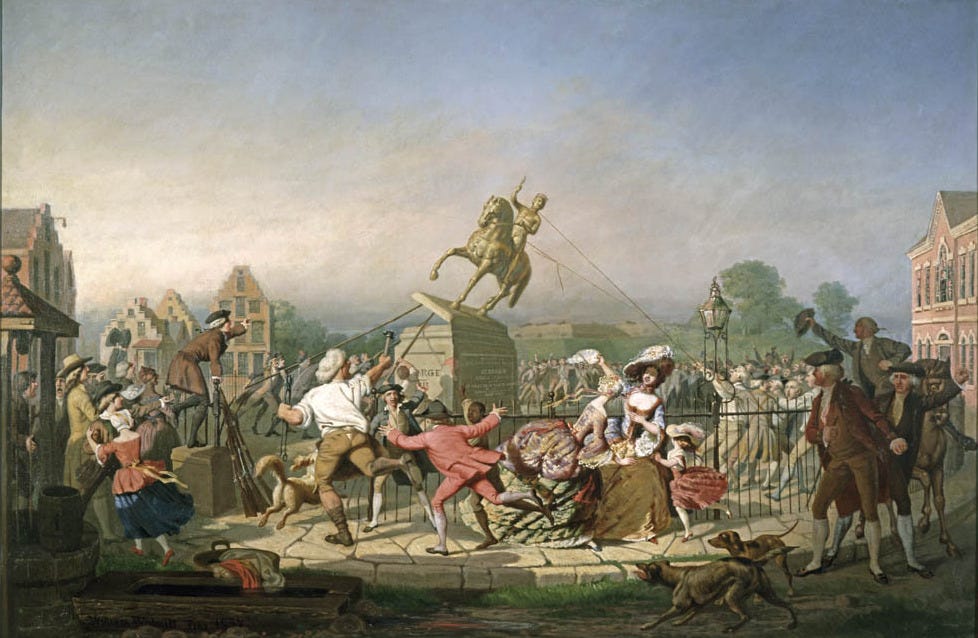
The spirit ran so strong that many of the soldiers, after leaving formation, joined a growing mob marching towards Bowling Green at the south tip of Manhattan. There stood a gilded lead statue erected in 1770 as a symbol of the power of the British Crown. The 4,000-pound figure of King George III sitting atop a horse was no match to the mob. It was torn down, torn to pieces, and turned into bullets for Patriot muskets. If there was any question about their affection for the king, it was answered at that moment.
I’m gonna be honest, I was hoping I would have more to say. Perhaps a long reflection on the fact that 250 years after the signing of the Declaration—more than ten generations!—the country still stands tall. Or maybe a long manifesto of where this country has gone wrong, all the missteps and misdeeds full of the anxieties and conspiracies of a Pynchon novel. Or maybe a prescription for the future to fulfill the promise set out in the first paragraphs of the Declaration describing the reason for America’s existence in the first place.
But I won’t. At least not today.
Partly this is laziness. Compiling the many thoughts I’ve had and sources I’ve read to do any of these is a lot of work. That is also ignoring the fact that the chronicling of the Revolution through people, events, and philosophy that I am currently doing is a lot of work to begin with. But, I know in my heart I could put aside all my other projects and make the time for this if I cared enough.
Part of it is also exhaustion. The outrage cycle, the kayfabe, the conspiracism, the populism. It’s all endless noise. I would feel right at home atop Mount Crumpit. Even those who are paid to parse this stuff struggle to find solid signals. So I have disengaged. I should probably look even less, as should we all, but no man is perfect. And thus, I feel a strong desire to write about my vision of America, but feel that I would just be adding to the noise.
But mostly it is uncertainty. Finding answers for why we are, to steal from Tocqueville, restless as a nation in the midst of so much abundance has become my white whale. Luckily, I have other responsibilities that force me away from becoming another Ahab. My essays on virtues and liberalism were really only the first step on this journey, and I do continue to find parallels between history and today that are worth discussing. But, I also have a hundred books surrounding this topic and have only just scratched the surface.
If I am going to diagnose and prescribe medicine to this seemingly ailing country, I first must determine the symptoms. But each symptom I find could be interpreted as either a positive natural phenomenon or an existential pathology. Am I becoing a hypochondriac by proxy or a persistent caregiver? The more I read, the more I realize it is often both.
Liberalism has been a marvel when it comes to expanding the rights and possibilities of humanity. We are far better off now with our freedoms than in any period in history, no matter what the RETVRN folks may claim about English peasants. But, in flattening hierarchies, we have also lost some of our will to enforce virtues and punish vices. We are all vessels of nothing more than our own emotions with no stable grounding in our beliefs.
Similarly, capitalism, free trade, and technological innovation have brought forth a material abundance that would make our ancestors faint. Fresh food from across the world can be found in every supermarket, innovations in prescription drugs make life easier for millions, every fact of the world is available in my pocket from anywhere. I can buy avocados in Minnesota in January! But when I want to buy a shelf for my office I get to choose from reputable names like BAYKA, and HOOBRO, and QEEIG and donate directly to the CCP.
All of this is without saying anything about the history and culture of this nation. Slavery and Reconstruction, immigrant struggles and success stories, Jim Crow and Civil Rights, Hiroshima and D-Day, race riots and freedom marches, manifestos and manuscripts. We contain multitudes!
America, like every nation on earth existing or extinct, has stains across its tapestry, but beneath that it is uniquely beautiful. We are a giant place filled with diverse people with unique problems. We are enigmatic with all the good and bad that comes from that. And I love it.
The recent influx of Europeans during the World Cup has really made me realize how much I really do. The shock and awe at what we find ordinary is enough to make my heart burst with patriotism. We may have lost ourselves to partisan fights and anonymity online, but out there, in the real world with grass beneath your feet, America is still a wonderful, welcoming, stunning place with people who are longing for community.
So on this celebration of American independence, we must remind ourselves about the purpose of the experiment being run here that was started in that stuffy room in Philadelphia, and also remember the final words of the Declaration:
And for the support of this Declaration, with a firm reliance on the protection of divine Providence, we mutually pledge to each other our Lives, our Fortunes and our sacred Honor.
The Declaration starts with rights and is filled with grievance, but it ends in obligation. Just like the founders, we are in this experiment together. We are tied to one another despite the differences that exist between many of us. A collapse of this is a collapse for all of us, and likely much of the world. To wish for this, or to stand by and watch it happen, is unconscionable. The loss of perspective and understanding that has become so common is troubling, but we are not destined for ruin.
No matter the chaos we feel on this 250th year of this country, we must remain proud of what it represents and stand in awe of its beauty. We must never forget the long battles fought throughout our history to live up to our ideals, but we also must not let the sins overcome us. There is a reason we have been the beacon of light in the world for so long. We are the bastion of the huddled masses, but we are also the incubator of genius, and a spreader of freedom. Yes, we are imperfect, often borderline irresponsible, in performing these duties, but if we keep in mind those self-evident truths, wrong turns can be corrected.
Most important of all, though, is to enjoy this day with people you love, in the nation you love, eating the food that you love. And if you can’t let this describe you, then I hope some day you join us. The view is breathtaking.
Happy Fourth of July.